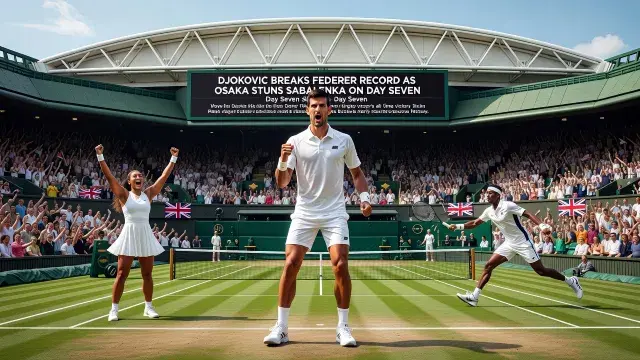
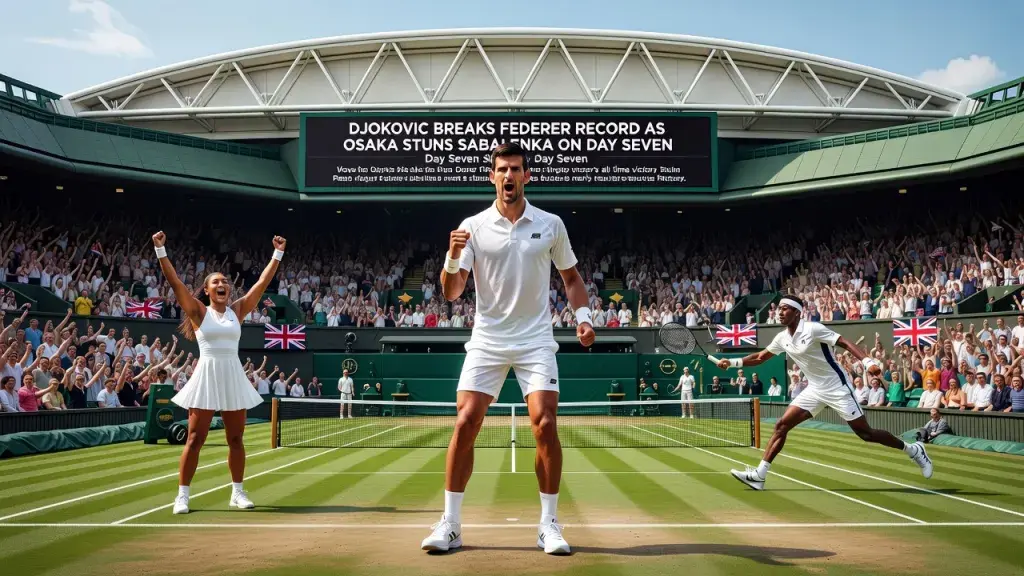
Wimbledon's seventh day delivered precisely what the All England Club tends to promise when the second week approaches: records shattered, top seeds wobbled, and the draw clarifying into something genuinely compelling. Novak Djokovic extended his own legend by surpassing Roger Federer's record for the most men's singles victories in Wimbledon history, while Naomi Osaka produced one of the most significant upsets of the women's draw by eliminating world number one Aryna Sabalenka. Felix Auger-Aliassime, seeded third, confirmed his credentials with a hard-fought victory that now puts him on a collision course with Djokovic.
The scale of what was accomplished on Monday stretched beyond individual matches. Djokovic's record-breaking win places him alone at the summit of Wimbledon's all-time men's singles victories list, a statistical landmark that underlines just how thoroughly he has dominated the grass-court Grand Slam across his career. For context, the milestone arrives in front of a crowd at SW19 that has at times been ambivalent toward him - yet the tennis has always spoken clearly enough. It is the kind of generational achievement that, much like tracking a national team's progress toward a historic knockout stage appearance - such as following the morocco round of 16 2026 world cup atlanta narrative - speaks to persistence, consistency, and the accumulation of defining moments over years rather than weeks. Djokovic now awaits Auger-Aliassime in the semi-finals, a matchup that will test the Canadian's composure against the most decorated grass-court player of his generation.
Auger-Aliassime's passage through to that semi-final was earned the hard way. His contest against Alejandro Davidovich Fokina was the kind of grinding, attritional match that reveals more about a player's mental fibre than any comfortable straight-sets win could. The Canadian, who has steadily matured into one of the most complete players on tour, held his nerve through the physical demands of a contest that could have gone either way. Facing Djokovic now represents the defining challenge of his Wimbledon campaign and, arguably, one of the most significant matches of his career to date.
Osaka Delivers the Upset of the Tournament
If Djokovic's record was the headline statistic of the day, Naomi Osaka's victory over Aryna Sabalenka was its most dramatic sporting moment. Sabalenka arrived at Wimbledon as the world number one and among the favourites for the title. Osaka, by contrast, has long been associated with hard courts - her Grand Slam titles have all come on that surface - making this quarter-final appearance at a non-hardcourt major a genuine first in her career. That context amplifies what she achieved. Defeating the top seed on grass, at Wimbledon specifically, is not a result anyone had mapped out as likely. Osaka now advances into the last eight with momentum, belief, and a point to prove about the breadth of her game.
Czech Rivalry and American Resilience Round Out the Day
The women's draw produced further intrigue through a meeting of Czech compatriots, with Karolina Muchova outlasting Barbora Krejcikova in what was a technically rich and emotionally charged encounter. Matches between players who know each other's game intimately - as national teammates do - often carry an unusual tension, and Muchova's ability to edge it speaks to her current form and competitive intelligence on grass. Jessica Pegula, meanwhile, came through against Iva Jovic in a match that required resilience rather than brilliance, the kind of win that often matters more in a deep Grand Slam run. Pegula has established herself as a consistent presence at the top of the women's game, and another quarter-final appearance reinforces that standing.
What the Second Week Promises
Wimbledon's second week now takes shape with a draw that offers genuine intrigue across both tournaments. Djokovic against Auger-Aliassime is the standout men's fixture, a test of whether the Canadian's power and athleticism can trouble a champion who has spent the better part of two decades mastering these courts. On the women's side, Osaka's run introduces an element of unpredictability that makes the quarter-finals harder to call. Muchova and Pegula add further competitive depth. The All England Club has, once again, arrived at the sharp end of a major with its traditions intact and its drama undiminished.
With inputs from agencies.