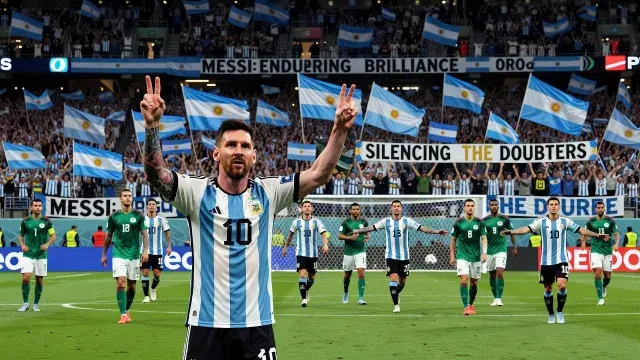
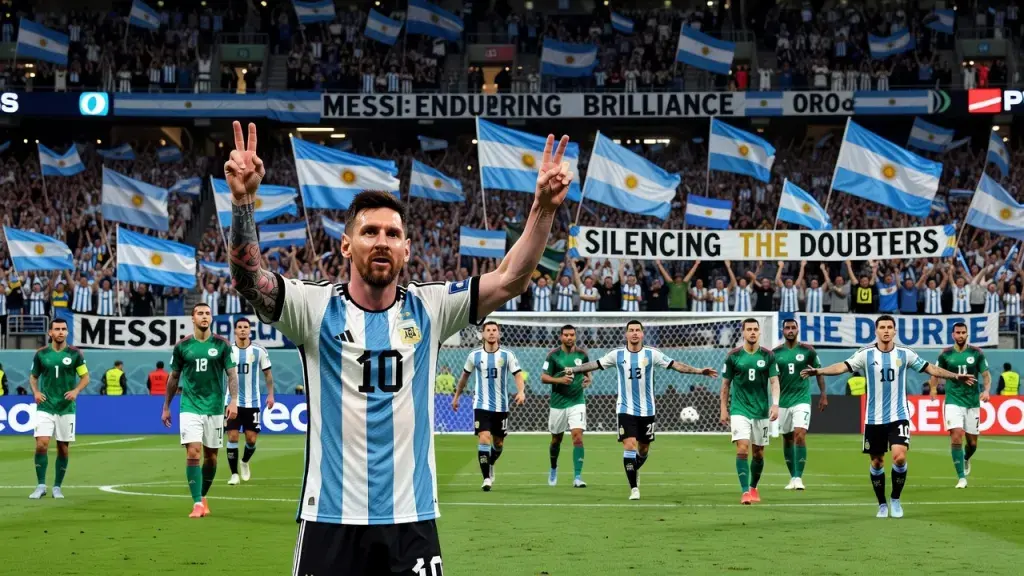
Lionel Messi answered every question about his relevance at 38 in the most definitive way imaginable. The Argentine captain scored all three goals in a commanding 3-0 victory over Algeria in Kansas City, delivering one of the most emphatic opening-match performances the World Cup has seen from a player at his stage of career. The doubts that had gathered around him in the months prior evaporated inside ninety minutes.
Those doubts had been genuine and, in fairness, reasonable. Messi's move to Inter Miami and the comparative comfort of MLS competition had prompted legitimate questions about whether the competitive edge required to decide matches at a World Cup could survive a less demanding weekly routine. Some observers, accustomed to tracking elite football the way a punter tracks form - with the same forensic attention a racing post greyhound bet demands before committing to a selection - had begun to wonder whether the sharpness simply would not be there when it mattered most. Against Algeria, it emphatically was.
The performance was a reminder that Messi's game has never been built solely on pace or physicality. It is built on positioning, decision-making, and an almost supernatural ability to exploit space when opponents fail to close him down quickly enough. Algeria, for all their organisation, afforded him room at critical moments, and he punished each instance with clinical precision. A hat-trick at a World Cup group stage, at 38, is not a statistical footnote. It is a statement.
A Team Built Around One Man - And At Peace With That
What the performance also confirmed is something that has defined the Scaloni era from its earliest days. Argentina are a collective with genuine quality throughout the squad - disciplined in shape, aggressive in the press, technically sound across multiple positions - but the system is arranged, consciously and unapologetically, to serve Messi. Passing lanes are created for him. Runners are timed to draw defenders away from him. Set-piece delivery is calibrated to his movement. It is not a criticism. It is simply the logic of having the greatest player of his generation available and choosing to use him properly.
Scaloni has never pretended otherwise, and the players around Messi have shown no resentment toward that dynamic. The 2022 World Cup triumph in Qatar cemented the understanding within the squad that subordinating individual ambition to collective purpose - with Messi as the focal point - produces results. This current campaign begins from that same foundation, reinforced rather than undermined by what happened in Kansas City.
What This Means for Argentina's Tournament Outlook
A single group-stage result must not be over-read. Algeria are a capable side with real quality in their squad, but they are not among the tournament's elite contenders, and Argentina were expected to win. The manner of the victory, however, adds context that matters. Messi was not peripheral and occasionally influential. He was dominant from early in the match, active in his movement and decisive in front of goal. That level of engagement across a full tournament, over multiple knockout rounds, would represent a different challenge entirely.
The fixtures ahead will test Argentina against stronger defensive units with greater tactical sophistication. How Messi performs when space is actively denied, when opponents plan specifically around eliminating his influence, will tell a more complete story. But after one match, the case for Argentina as genuine title contenders is considerably stronger than it was before kick-off - and so is the case that Messi, defying age and expectation alike, intends to have the final word at the last World Cup of his career.