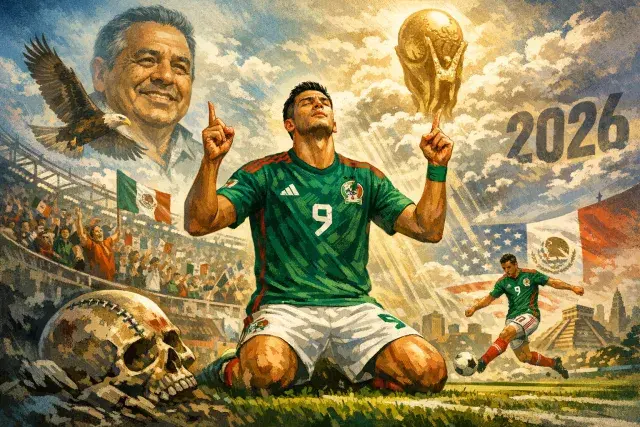
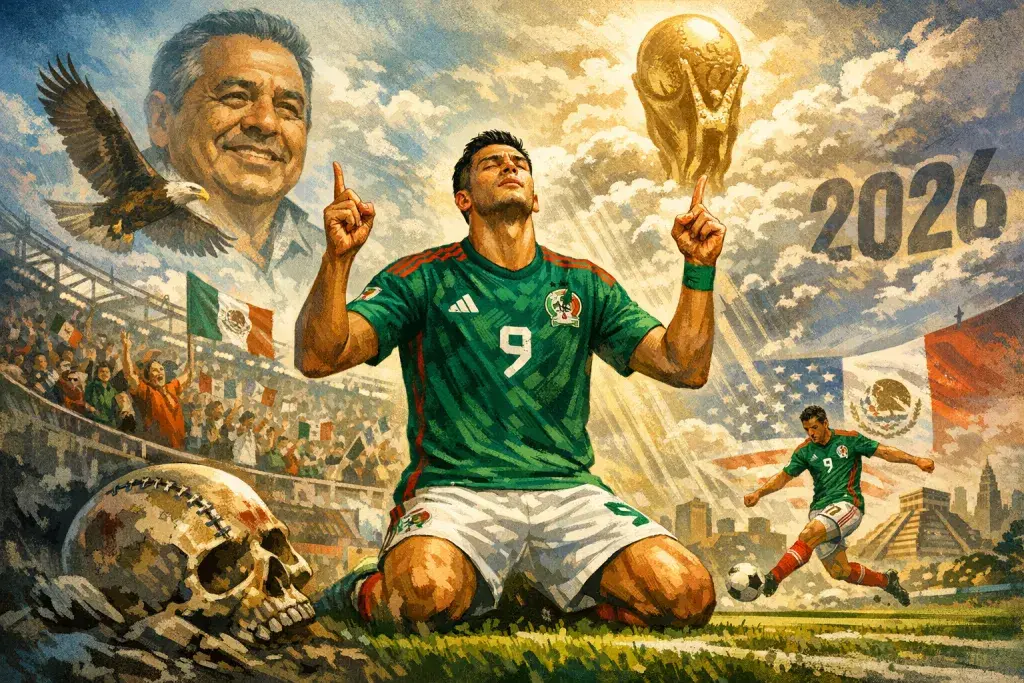
Raul Jimenez scored a goal, fell to his knees, closed his eyes, and pointed to the sky. It was not simply a celebration. It was a conversation with someone who was no longer there. Days after the passing of his father, Raul Jimenez Vega, the Mexico striker processed his loss the only way he knew how — by doing what his father had always supported him in doing. The moment distilled everything that defines him: resilience built not from abstraction, but from real and recurring loss.
A Son's Grief Becomes a Striker's Purpose
Losing a parent reconfigures the way motivation works. What once felt important can become urgent. What once felt personal becomes also an act of tribute. Jimenez articulated this with unusual clarity when speaking to GOAL. "My dad, he was always supporting me," he said. "He was always a really important part of my career, and I really appreciate that, because he and my whole family always supported me. It doesn't matter what I needed or where I needed to travel for the games, they were always with me. It's an extra motivation."
That language — "extra motivation" — is not the deflection it might sound like. For Jimenez, the drive to represent something larger than personal ambition has been present since he first left Mexico for Europe. The death of his father has not introduced that sense of responsibility. It has deepened it. "He's going to be really proud," Jimenez said. "He'll be proud of what I'm going to achieve with the national team in the World Cup." Those words carry the particular weight of someone speaking not to a journalist, but to a memory.
A Career Built on Surviving What Should Have Ended It
Jimenez's path through professional football — from Club America to Atletico Madrid, from Benfica to Wolverhampton Wanderers, then Fulham — has been shaped as much by setbacks as by talent. The fracture to his skull sustained in November 2020 during a Premier League fixture was not a minor injury requiring rest. It was a life-threatening event that required emergency surgery. The questions that followed were not about form. They were about whether he would ever return at all.
He did return. More than that, he rebuilt. At Fulham, already past thirty, he scored ten goals in a single calendar year and contributed nine times in fourteen appearances for the national side, including decisive contributions in the CONCACAF Nations League and Gold Cup final against the United States. These are not the numbers of a player managing decline. They are the numbers of someone who found a second version of himself after the first one very nearly disappeared.
"I look back on those moments with a lot of gratitude, knowing that everything happens for a reason," Jimenez told GOAL. "I wouldn't change anything, not the good, not the bad things. Being persistent, being resilient — it's always something that has characterized me, and I want to keep pushing. I'm 34 years old, and it's not something that's going to take me back."
A Home World Cup and the Weight of Unfinished Business
Across three previous World Cups, Jimenez has worn the number nine for Mexico without ever starting a single fixture. That is a striking biographical detail — not a mark of failure, but of circumstance, of competition, of the particular cruelty of squad selection. Now, at 34, with the tournament on home soil, that is set to change. He enters 2026 as arguably the most prominent figure in an El Tri setup that will face enormous domestic expectation.
Mexico's all-time scoring record belongs to Javier Hernandez. Jimenez stands third on that list, within reach of second place. Whether the records fall matters less than what Jimenez himself says he is chasing. "We want to remember this World Cup," he said, "and not only because it's at home. We want to remember it as being one of the best World Cups in Mexican history. We want to fight. We want to give our best in every game." He named South Africa, England, and Spain in the same breath — not as obstacles to fear, but as proof of ambition unfiltered by caution.
The Audience He Plays For
When Jimenez describes what this moment means, his mind does not go to arenas. It goes to living rooms. He pictures families gathered around televisions, the kind of collective experience that defined his own childhood. He thinks about the bars and restaurants where communities will form around a shared identity, briefly collapsing the distance between strangers. He has partnered with Modelo ahead of the World Cup precisely to articulate that — the idea that the real audience for this tournament is counted in millions, not in stadium capacities.
"It's really an extra boost for us," he said of that public support. The word "us" is doing real work there. Jimenez does not separate himself from the people watching. He understands, with the clarity that only comes from growing up the way he did, that his story and theirs are the same story — one of aspiration, of departure, of effort, and of the hope that someone out there is doing something worth celebrating together. His father believed that. Jimenez is still proving it.