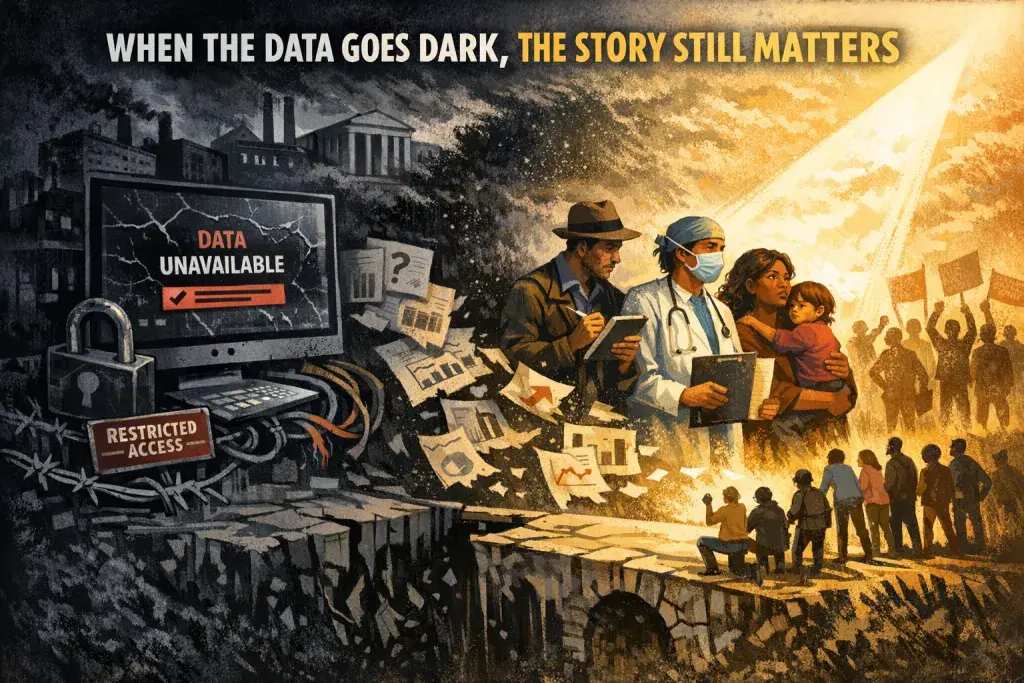
The absence of information is itself a form of information. When data becomes unavailable — whether due to system failure, deliberate restriction, institutional breakdown, or the simple lag between events and their documentation — the gap left behind has real consequences for decision-making, public understanding, and accountability. This is not a technical inconvenience. It is a structural problem with direct human costs.
Why Data Gaps Are Never Neutral
Every missing dataset represents decisions that cannot be made well. Public health officials need case counts. Policymakers need economic indicators. Journalists need records. When those inputs disappear, the people who depend on them do not stop operating — they operate with less certainty, often defaulting to assumption, precedent, or institutional habit rather than evidence. The outcomes are predictably less reliable.
Data unavailability tends to fall hardest on those with the least power to compensate for it. Wealthier institutions can commission their own research or wait out an information gap. Individuals, smaller organizations, and under-resourced communities typically cannot. A missing public health dataset may delay a local clinic's response. A missing environmental record may prevent a community from building a legal case. The asymmetry is consistent and worth naming plainly.
The Many Faces of Unavailability
Not all data gaps share the same origin, and the distinction matters. Some are technical: servers fail, systems migrate, formats become obsolete. Some are financial: data collection requires sustained funding, and when budgets contract, monitoring programs are among the first casualties. Some are political: governments and institutions restrict access to information that reflects poorly on them, reclassify records, or simply decline to collect data on phenomena they would prefer not to measure.
There is also a subtler category — data that technically exists but is fragmented across incompatible systems, locked behind access requirements that most people cannot meet, or stored in formats that require specialist tools to interpret. Availability is not binary. A dataset that exists but cannot practically be used is, for most purposes, a dataset that does not exist.
Transparency as Infrastructure
Open data policies, when properly implemented, treat information as a form of public infrastructure — like roads or power grids, maintained for collective use. The logic is straightforward: data collected using public resources, or describing conditions that affect the public, should be accessible to the public. The principle is widely endorsed. The practice is considerably more uneven.
What effective data transparency requires is not just the legal right to access information, but the practical conditions that make access meaningful: standardized formats, maintained archives, clear documentation, and the funding to sustain these systems over time. Short-term data collection projects that generate a single report before closing their doors produce a different kind of gap — one that is harder to see because it resembles completeness from the outside.
Reading the Silence
Responsible analysis in conditions of data unavailability demands honesty about the limits of what can be known. The temptation to fill gaps with confident inference is understandable but frequently misleading. What can be said, with care, is that the absence of data in a particular domain often reflects something real about how that domain is prioritized — or deprioritized — by the institutions responsible for measuring it.
When the data is unavailable, the first question worth asking is not how to work around the gap, but why the gap exists. The answer is rarely purely technical. And the willingness to ask it honestly is itself a form of accountability.